
Music Tabs
Tablature (tab) shows music as fret numbers on lines that stand for the strings, which makes it the quickest way to write down a riff or share a song part. This tab maker gives you a grid for guitar, bass or ukulele: type fret numbers, add hammer-ons, pull-offs and slides, play it back to check it sounds right, and export neat text tab you can paste anywhere or print.
- Free to use
- No sign-up
- Runs in your browser
Tab maker
Type a fret number (0–24). Letters are allowed after a number: h (hammer-on), p (pull-off), / \ (slide up/down), b (bend), x (muted). Arrow keys move between cells.
Tab Paper and Symbols Pack
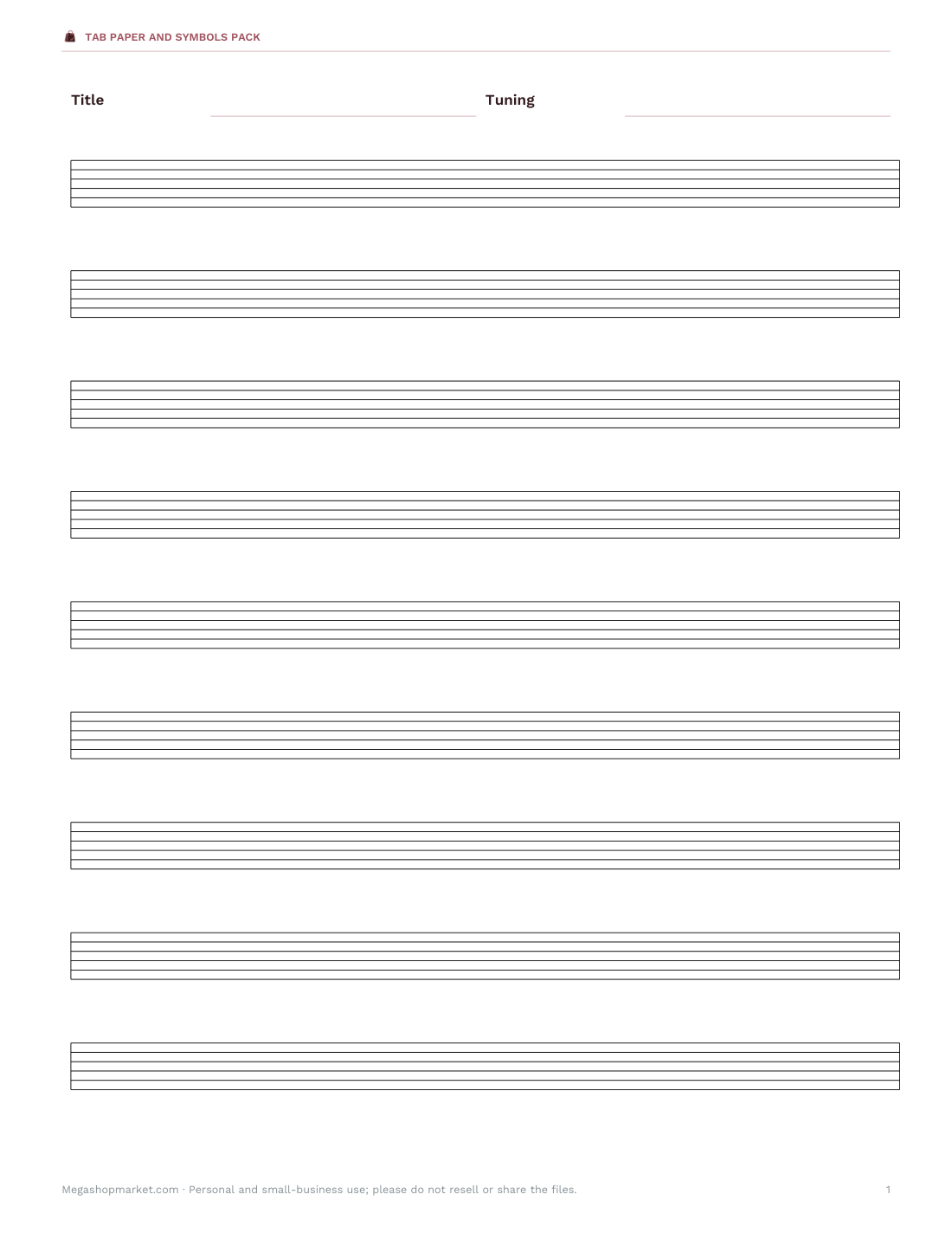
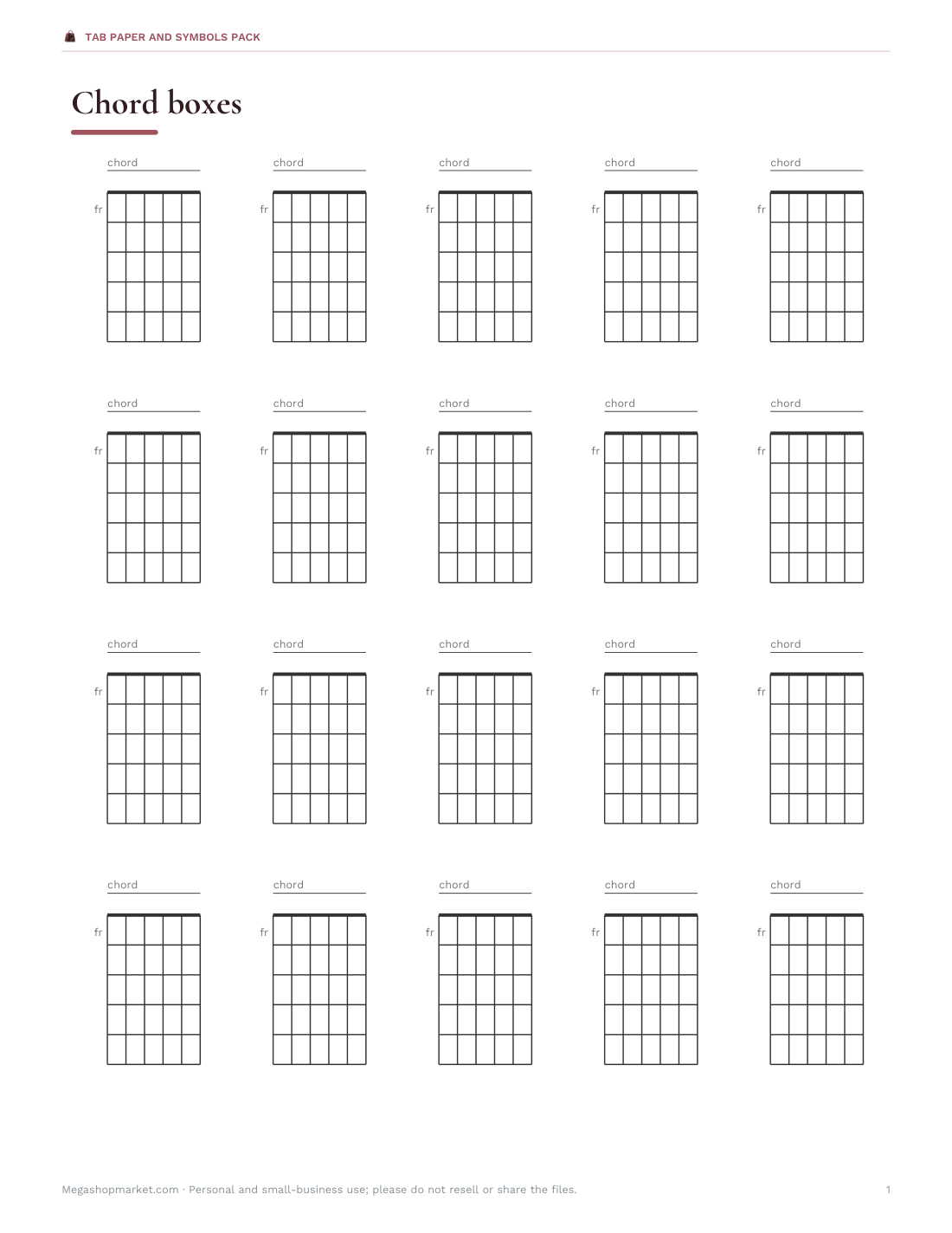
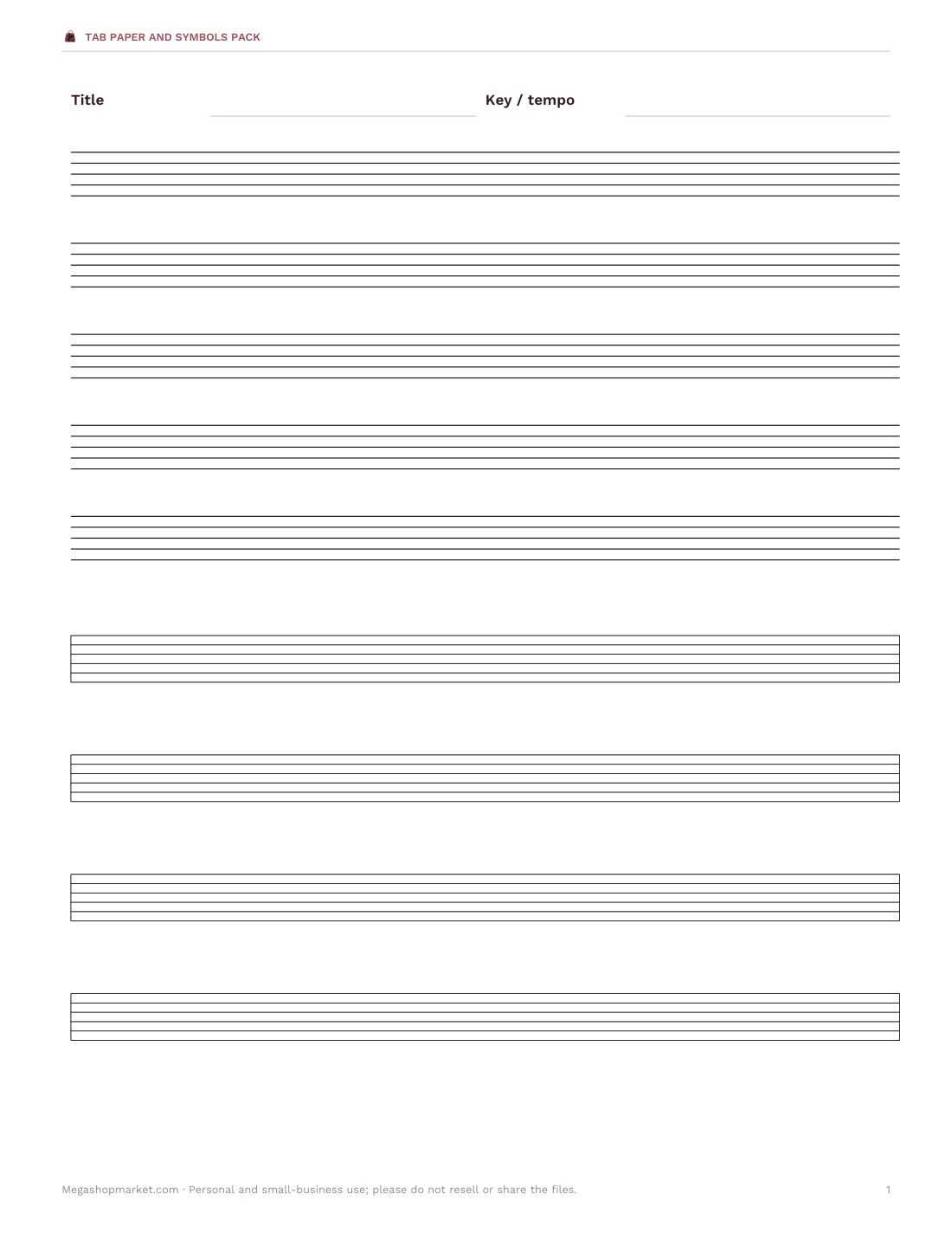
Printable blank guitar tab paper, bass tab, tab with a staff, chord box sheets, a tab symbols cheat sheet and a practice log.
- Guitar tab paper (PDF)
- Chord boxes (PDF)
- Staff with tab (PDF)
- Symbols sheet (PDF/XLSX)
- Practice log (PDF/DOCX/XLSX)
Formats: PDF, XLSX, DOCX. Instant download after payment (link valid 72 hours, up to 5 downloads). AI-assisted: the templates were drafted with AI help and reviewed and laid out before publishing.
$5.00 USD, one-time 5 files · about $1.00 each
- Instant download
- 7-day refund
- Secure checkout by Stripe
✓ Classroom use included
7-day money-back guarantee. Full refund within 7 days of purchase, even after you download.
Free sample: Blank Guitar Tab (PDF, 46 KB)
Full refund within 7 days — see the refund policy and license.
License: personal and classroom use. Teachers may print and photocopy these files for the students in their own classes, and share them in a password-protected class space (e.g. Google Classroom). Please do not resell, redistribute, or post the files on public websites. One purchase covers one teacher.
Free printables
Single sheets you can print right now, no sign-up. The full pack adds every sheet in one download plus the editable files.
 Printable Guitar Tab Paper
 Printable Chord Boxes PDF
 Printable Staff with Tab Sheet
 Printable Guitar Tab Symbols Chart
 Printable Guitar Practice Log
How to read tab
Each horizontal line is a string. On guitar tab the top line is the thinnest, highest string (high e) and the bottom line is the thickest (low E) — the opposite of how the strings look when you glance down at the guitar, but the same as looking at the fretboard in a mirror. A number tells you which fret to press on that string: 0 means play the string open, 3 means press the third fret. Numbers are read left to right; numbers stacked vertically are played together, as a chord.
Tab symbols
| Symbol | Meaning | Example |
|---|---|---|
| h | Hammer-on: pick the first note, then press the second without picking | 5h7 |
| p | Pull-off: pick the first note, then pull the finger off to sound the lower note | 7p5 |
| / | Slide up | 5/7 |
| \ | Slide down | 7\5 |
| b | Bend the string up (often with the target fret after it) | 7b9 |
| r | Release a bend | 7b9r7 |
| ~ | Vibrato | 7~ |
| x | Muted or dead note | x |
| | | Bar line | — |
Using the tab maker
- Choose guitar, bass or ukulele, and the tuning.
- Pick how many columns you need and where bar lines go.
- Click a cell and type a fret number; use the arrow keys to move around.
- Add a technique letter after a number, such as 5h7.
- Press Play to hear the notes in order at your chosen speed.
- Copy the text tab, download it or print it.
Tuning and string order
| Instrument | Tuning (low to high) | Tab line order (top to bottom) |
|---|---|---|
| Guitar, standard | E A D G B E | e B G D A E |
| Guitar, drop D | D A D G B E | e B G D A D |
| Bass, 4-string | E A D G | G D A E |
| Ukulele, standard (re-entrant) | G C E A (high G) | A E C G |
On a standard ukulele the G string is tuned higher than the C string, so the lowest-sounding note is the open C. The tab maker’s playback uses this re-entrant tuning.
Worked example: a C major scale
Load the example on guitar and you get a one-octave C major scale in open position: 3rd fret on the A string (C), then open D, 2nd fret D (E), 3rd fret D (F), open G, 2nd fret G (A), open B and 1st fret B (C). Play it back and you should hear “do, re, mi, fa, sol, la, ti, do”. Try changing the tempo, then add a hammer-on by typing 0h2 on the D string.
Writing chords in tab
To write a chord, stack the fret numbers in one column: an open C major chord on guitar is x-3-2-0-1-0 from low E to high e, so in the tab maker you type 3 on the A line, 2 on the D line, 0 on G, 1 on B and 0 on high e in the same column, and leave the low E empty or type x. To show strumming, repeat the column several times, or write the chord name above the tab in your notes.
Practice tips for learning from tab
- Start slowly: set the playback speed low, and play along at that tempo.
- Loop difficult bars — write just those columns in a new tab and practise them alone.
- Say the fret numbers aloud as you play to connect the page to your fingers.
- Listen to the original recording to learn the rhythm that plain tab leaves out.
- Use a metronome and increase the tempo only when you can play cleanly three times in a row.
Alternate tunings
Many songs use tunings other than standard. Drop D lowers the low E string a whole step to D, making power chords playable with one finger. Open tunings such as open G (D G D G B D) and DADGAD are popular in blues, folk and slide guitar. Always write the tuning at the top of a tab so that anyone reading it tunes correctly first.
What tab doesn’t show
- Rhythm: plain tab usually doesn’t show note lengths, so learn the song by ear or use tab with rhythm notation.
- Which finger to use — choose what feels natural or follow a teacher.
- Dynamics and feel.
- Standard notation shows pitch and rhythm exactly; many books print both together.
Sharing tab responsibly
Tab you write yourself for your own riffs, exercises and arrangements of traditional or public-domain tunes is yours to share. Songs by other artists are usually protected by copyright, including their melodies and lyrics, so check the rules before publishing transcriptions of someone else’s music.
Printable tab paper
The optional pack includes blank guitar and bass tab paper, tab with a staff above, chord box sheets, a symbols cheat sheet and a practice log. The tab maker above is free to use and print.
AI-assisted content
Explanations were drafted with AI assistance and reviewed before publishing.
Frequently asked questions
What do the numbers in guitar tab mean?
The fret to press on that string; 0 means an open string.
Which line is the low E string?
The bottom line of guitar tab.
What does h mean in tab?
A hammer-on.
Can I make bass or ukulele tab?
Yes, choose the instrument and tuning.
Can I hear my tab?
Yes, press Play for a simple playback.
Does tab show rhythm?
Plain text tab usually does not.
How do I write a chord in tab?
Stack the fret numbers for each string in the same column.
May I print and share these worksheets with my class?
License: personal and classroom use. Teachers may print and photocopy these files for the students in their own classes, and share them in a password-protected class space (e.g. Google Classroom). Please do not resell, redistribute, or post the files on public websites. One purchase covers one teacher.